Davos After Munich
Did Carney’s message move the dial against Starmerism?

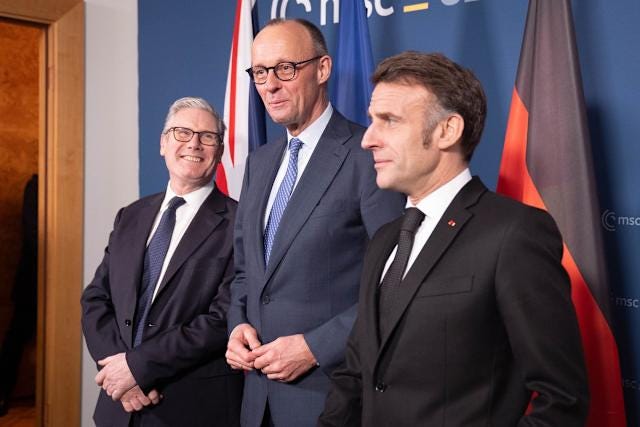
Last week’s Munich Security Conference (MSC) suggests that Prime Minister Mark Carney’s Davos speech, with its warning of geopolitical rupture and call for “principled and pragmatic” coordination among middle powers, continues to resonate.
Both in Canada and abroad, the speech often has been viewed as an attack on Trump. But was it?
Certainly, Trump is the 800-pound gorilla in the room. His presidency is not the entirety of the rupture Carney described, but it is undeniably part of it. Yet after a year of aborted negotiations and unpredictable outcomes, Carney likely understands that directly attacking Trump (or appearing to) is unlikely to produce concrete results. On the one hand, Trump’s worldview is unapologetically transactional. On the other, his decisions are often shaped by the last person in the room with him. Invoking Václav Havel was never going to determine the outcome of negotiations at the “Winter White House” in Mar-a-Lago.
So when the U.S. President responded to “Mark” in his own remarks at Davos, it seemed more a reaction to headlines than to the substance of the argument.
So if the speech was not primarily aimed at Trump, what was it?
A Counter to Starmerism
Carney’s Davos speech is better understood as a counter to Starmerism – the instinct to appease the bullies in the cafeteria who are determined to extract more and more lunch money from the other kids at the table, including those that used to be their friends, to maintain a precarious status quo from which they have previously benefitted.
Keir Starmer is, of course, the beleaguered Prime Minister of the UK – deeply unpopular at home with a government that has been rocked by the Epstein files. More to the point here, Starmer was the first global leader to give in to Trump’s tariffs. He offered little to no support for Canada when Trump has threatened annexation, instead offering Trump an “unprecedented” second state dinner with the King. (Admittedly, he has done better on Greenland.) And as Trump threatened Europe, Starmer found ways to stress the need to work with the US administration which has set out to overthrow the established order in the name of “Cultivating resistance to Europe’s current trajectory within European nations.”
US Secretary of State Marco Rubio effectively confirmed this approach in his own address at MSC, placing a velvet glove around the same blunt fist message sent by US Vice President JD Vance last year: that Europe is a victim of “the forces of civilizational erasure” which can only be halted by the unquestioned leadership of President Trump. If his words were softer, Rubio’s visits to the increasingly anti-EU and authoritarian Hungary and Slovakia spoke volumes about the trajectory of US foreign policy towards Europe.
To be fair, Starmer is not alone in his approach. NATO Secretary General Marke Rutte has frequently gushed praise of Trump, all of it undeserved, going so far as to call him “Daddy” in what was certainly one of the most cringe-inducing diplomatic moments of 2025. Rutte has bent over backwards to excuse behaviour that is, at best, troubling, telling allies and journalists to ignore the very bright red flags being waved from the White House. There is no doubt that in his NATO role Rutte is desperate to preserve the Atlantic Alliance – but for all his efforts, he has only received a vague promise not to use physical force to acquire Greenland and a promise that Trump will not yet destroy the Atlantic Alliance. US aid to Ukraine has dried to a trickle and the administration continues to favour Moscow in peace discussions.
Rupture or Renewal?
Getting back to Starmer, however, he clearly understood Carney’s Davos message. At MSC he offered a rebuttal of sorts, stating “Instead of a moment of rupture, we must make it one of radical renewal,” calling for integration rather than dependence with the US.
To be fair to the British Prime Minister, he made clear in his address that the UK must deepen its engagement with Europe in the face of Russian aggression, rather than rely predominantly on Washington — possibly signalling a recognition in Downing Street of the realities of working with Trump.
In many respects, Starmer, Rutte, and Carney likely want similar ends: a preserved NATO, a stable Europe, continued Western cooperation. The divergence lies in strategy — sweet talk versus collective structural strength.
But this strategy matters like never before.
As Carney put it:
“But when we only negotiate bilaterally with a hegemon, we negotiate from weakness. We accept what is offered. We compete with each other to be the most accommodating.
This is not sovereignty. It is the performance of sovereignty while accepting subordination.”
That critique lands squarely against bilateral accommodation, especially when it is based in flattery. Moreover, it is a warning that sovereignty cannot survive if middle powers undercut one another in pursuit of favour.
Munich’s Verdict – For now…
Judging from social media and reporting from the conference, Carney’s call for collective action in an era of rupture appears to have resonated most strongly at MSC. Although Rubio received a standing ovation for his speech, no one seems to take seriously his idea of partnership so long as the US continues to seek to undermine and dominate the European political and cultural order.
Indeed, reading the commentary from MSC (admittedly from my parent’s basement in Oshawa) the mantra seems to be “actions speak louder than words”. Nothing is going to matter more now for security than actually doing things independent (or at least less dependent) on the United States.
….But it’s not a popularity contest.
So what does this mean for us at home? Carney’s speech has been very well received and continues to resonate. But Canadians would be wrong to view the reception of Carney’s speech as an international moment of triumph. Carney’s diagnosis has been widely accepted, but Europe and the Indo-Pacific are not likely to be looking in Ottawa’s direction for leadership – yet. For too long Canadian leaders have made speeches about the importance of acting together, without following-up with much in the way of putting material contributions on the table. We have been content to state our values and interpreted this as meaningful action as the international order has increasingly crumbled.
In other words, Canada – and the Carney government – must operationalize Davos into a concrete plan of action. One that puts material contributions in the store window where Havel’s shopkeepers once put their signs.
Some ideas on how to do this in my next post.
I don't completely blame the trump appeasers. Seemed like the rational approach at the time. Likewise, I don't blame Carney for going all elbows up before realizing that doing so only hurts us more and reversing course. The next few months will be really difficult but I think Carney sensed the weakness in Trump's hand and is playing the longer game. We need to stick together and trust he is the right person to lead us through this. I think even PP in his heart of hearts may have figured that out. (Nah, scratch that last part. Who am I kidding?)